
192.168.100.1 Login: Router, Modem & Admin Access Guide
If you are trying to access 192.168.100.1, you may be looking for your router, modem, or fibre ONT settings. This private IP address is used by some network devices for local administration. If your device uses a different gateway, you can also check our 10.10.10.1 Router Login guide for another router access method.
What Is 192.168.100.1?
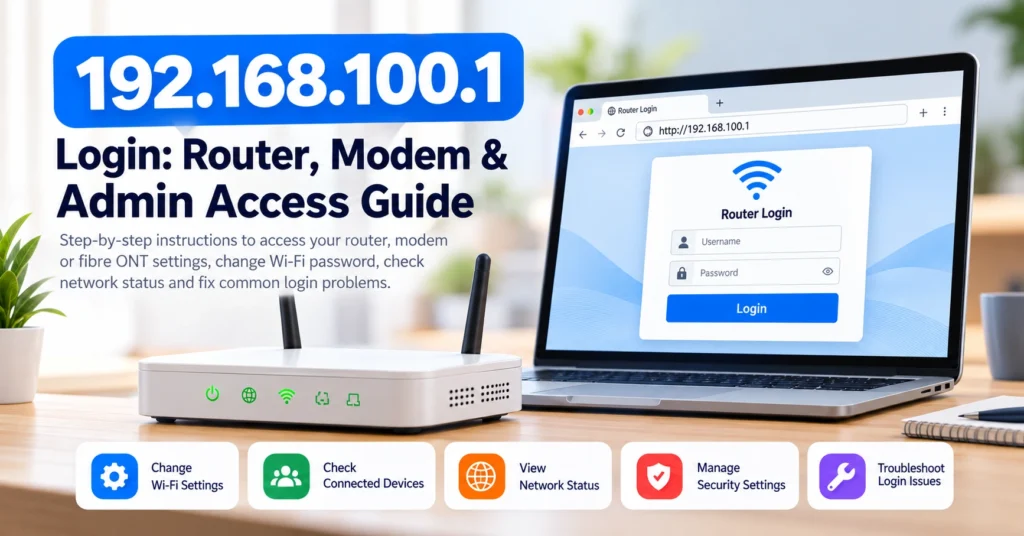
192.168.100.1 is a private IPv4 address used by some routers, modems, and fibre ONTs.
It is not a public website. You can normally access it only when your computer or phone is connected to the local network of the device using this address.
When supported by your device, entering 192.168.100.1 in a web browser can open a local administration page. From there, you may be able to manage Wi-Fi, network settings, connected devices, security options, and other device features.
However, 192.168.100.1 is not the default IP address for every router. Your device may use another address, so it is important to check the actual gateway if the page does not open.
How to Login to 192.168.100.1
The login process is usually simple.
Step 1: Connect to Your Router or ONT
First, connect your computer or phone to the correct network.
You can use:
- Wi-Fi
- Ethernet cable
- A LAN connection to the router or ONT
If you are using a phone, make sure it is connected to the Wi-Fi network managed by the device you want to access.
Step 2: Open a Web Browser
Open any modern browser, such as:
- Google Chrome
- Microsoft Edge
- Mozilla Firefox
- Safari
You do not need an internet connection to open a local router administration page, as long as your device is connected correctly to the local network.
Step 3: Enter 192.168.100.1
Type the following address directly into the browser’s address bar:
Do not type it into Google or another search engine.
The browser should try to connect directly to the local device.
Step 4: Enter Login Details
If the device uses an administrator login, you will see a username and password screen.
Enter the credentials assigned to your specific router, modem, or ONT.
There is no single universal username and password for 192.168.100.1.
The correct credentials can depend on:
- Router or modem model
- Firmware version
- Manufacturer
- ISP configuration
- Device administrator settings
Check the label on your device, the documentation supplied with it, or the manufacturer’s instructions if you do not know the login details.
Step 5: Open the Admin Panel
After successful authentication, you should reach the device’s administration interface.
Depending on the model, you may see sections for:
- Wi-Fi
- WLAN
- Internet
- LAN
- WAN
- Connected devices
- Security
- System settings
- Network status
- Administration
The exact options vary between devices.
What If 192.168.100.1 Does Not Open?
This is one of the most common problems.
If the browser shows an error such as “This site can’t be reached”, “Connection refused”, or simply keeps loading, do not immediately assume that the router is broken.
The device may simply be using another local IP address.
1. Check Your Network Connection
Make sure your computer or phone is connected to the correct router or ONT.
If you are connected to another Wi-Fi network, the address may not work.
2. Check the Default Gateway
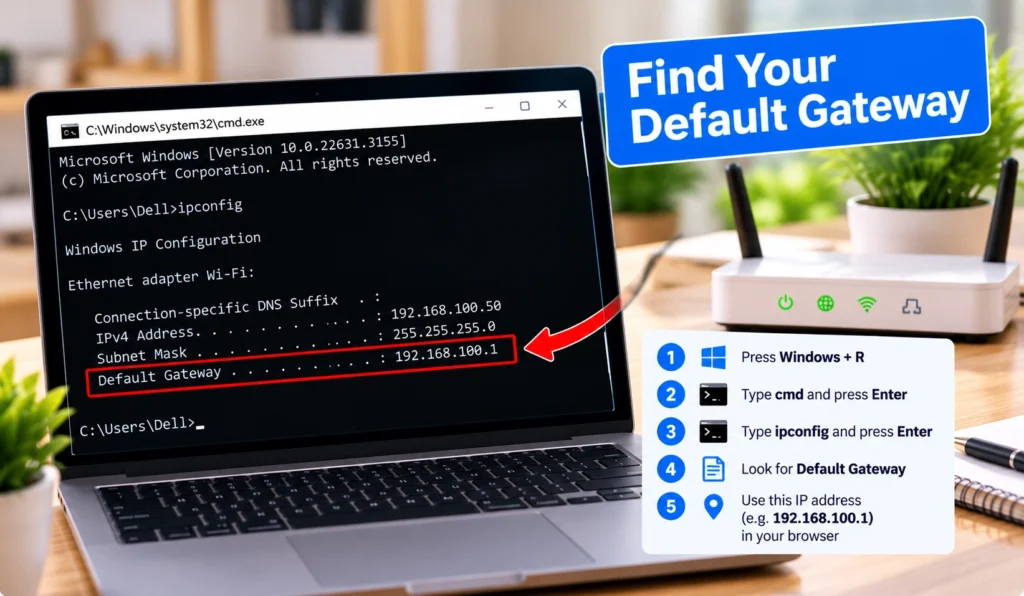
The best way to confirm the correct router address is to check the default gateway.
On Windows:
- Press Windows + R.
- Type cmd.
- Press Enter.
- Type ipconfig.
- Press Enter.
- Find Default Gateway.
If the gateway is:
192.168.100.1
then that is the local address your device is currently using.
If another address appears, use that address instead.
3. Check the Address Carefully
A small typing mistake can prevent the page from opening.
The correct address is:
192.168.100.1
Make sure you do not accidentally add extra numbers or change the dots.
For example:
- 192.168.100.1
- 192.168.1.100
- 192.168.0.1
- 192.168.10.1
These are different IP addresses.
4. Turn Off Mobile Data Temporarily
If you are trying to access the address from a smartphone, temporarily turn off mobile data.
Keep your phone connected to Wi-Fi.
5. Disable VPN Temporarily
A VPN can sometimes interfere with access to local network addresses.
If you have an active VPN, disconnect it temporarily and try 192.168.100.1 again.
6. Try Another Browser
Try another browser if the page does not load.
7. Restart the Router or ONT
If the device is not responding, restart it.
Turn the device off, wait briefly, and turn it back on. Give it enough time to complete its startup process before trying the address again.
How to Find the Correct Router IP Address
If 192.168.100.1 does not work, finding the actual gateway is usually better than guessing different IP addresses.
Windows
Open Command Prompt and run:
ipconfig
Look for:
Default Gateway
The number next to it is normally the local gateway used by your device.
Android
The exact menu names vary by Android version and manufacturer.
Usually:
- Open Settings.
- Open Wi-Fi.
- Tap the connected network.
- Open network details.
- Look for Gateway, Router, or similar information.
iPhone
On an iPhone:
- Open Settings.
- Tap Wi-Fi.
- Tap the information icon next to your connected network.
- Look for Router.
The value shown beside Router is the local gateway address.
Router vs Modem vs Fibre ONT
One reason people become confused about 192.168.100.1 is that the address may belong to different types of network equipment.
Router
A router connects devices on your local network and manages network traffic.
It commonly provides:
- Wi-Fi
- DHCP
- LAN settings
- Connected-device management
- Firewall settings
Modem
A modem connects your network to the service provided by your internet connection.
Depending on the equipment, the modem may also include routing and Wi-Fi functions.
How 192.168.100.1 Can Be Used by an ONT
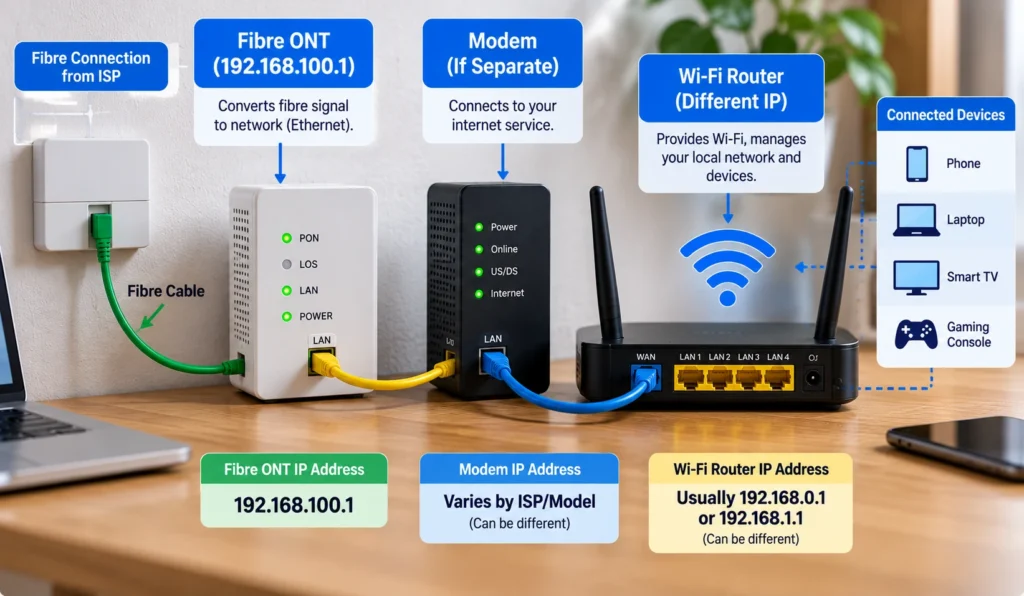
An Optical Network Terminal (ONT) is a device commonly used with fibre internet. It converts the signal coming through the fibre cable into a network connection that your router and other devices can use.
Some ONTs have their own local admin panel, and 192.168.100.1 may be the address used to access it.
Important: Your ONT and Wi-Fi router can be separate devices, and they may use different IP addresses.
For example, your network may look like this:
Internet → Fibre ONT → Wi-Fi Router → Your Devices
In this setup, the Fibre ONT may use 192.168.100.1, while the Wi-Fi router may use a different private IP address.
So, if entering 192.168.100.1 opens an ONT settings page instead of your Wi-Fi router’s admin panel, this is not necessarily a problem. It simply means that 192.168.100.1 belongs to the ONT in your network setup.
What Can You Do After Logging In?
The available settings depend on your device and account permissions.
Change Wi-Fi Name
You may be able to change the wireless network name, also called the SSID.
Change Wi-Fi Password
You may also be able to change your wireless password.
Choose a strong password that is difficult for other people to guess.
Check Connected Devices
Many router interfaces show devices currently connected to the network.
This can help you identify:
- Phones
- Laptops
- Smart TVs
- Printers
- Other network devices
Check Network Status
Depending on the equipment, you may be able to view:
- WAN status
- LAN status
- Wi-Fi status
- Connection status
- Device uptime
- Fibre status
Manage Security
Some devices provide options related to:
- Firewall
- Access control
- Guest Wi-Fi
- Wireless security
- Password management
Do not change advanced settings unless you understand what they do.
Admin Password vs Wi-Fi Password
These two passwords are often confused.
Wi-Fi Password
The Wi-Fi password is used to connect your phone, laptop, TV, or other device to the wireless network.
Admin Password
The administrator password is used to access the router, modem, or ONT settings.
They may be different.
PPPoE Password
Some internet connections also use a PPPoE username and password.
These credentials are used for the internet connection itself and are not necessarily the same as your router’s administrator login.
Why Are Some Router Settings Locked?
You may successfully log in to 192.168.100.1 but still find that some options are unavailable.
This can happen when:
- The device is managed by an ISP.
- Your account has limited administrator permissions.
- The firmware hides advanced settings.
- The device is configured for a specific network service.
- You are using a lower-level user account.
Logging in successfully does not necessarily mean you have access to every setting.
What Are PON and LOS on a Fibre ONT?
If 192.168.100.1 opens a fibre ONT interface, you may see optical connection information.
PON
PON refers to the Passive Optical Network connection.
A normal PON status generally indicates that the ONT has established an optical connection with the provider’s network.
LOS
LOS means Loss of Signal.
If the LOS indicator is active or showing a fault condition, there may be an issue with the optical connection.
Possible causes include:
- Fibre cable problems
- Loose connections
- Optical signal issues
- Provider-side problems
- ONT faults
Can You Access 192.168.100.1 Without Internet?
Can You Access 192.168.100.1 Without Internet?
Yes, in many cases. You do not always need an active internet connection to open your router or ONT’s local admin page.
The key difference is between local network access and internet access. As long as your device is connected to the router or ONT through Wi-Fi or an Ethernet cable, you may still be able to open 192.168.100.1 even when the internet is down.
How it works:
Your Device → Wi-Fi / Ethernet → Router or ONT → 192.168.100.1
For example, if your internet service stops working but your phone or computer is still connected to the router, you can often access the local admin page to check network settings, connection status, or other troubleshooting options.
192.168.100.1 vs 192.168.1.1 vs 192.168.0.1
These are all private IPv4 addresses, but they are not interchangeable.
A device using 192.168.100.1 will not automatically respond to 192.168.0.1.
Different manufacturers, routers, modems, and network configurations can use different private addresses.
If your device uses 192.168.0.1, you can use our 192.168.0.1 guide for the relevant login and troubleshooting information.
The important point is:
Always use the IP address assigned to your actual network device.
Common 192.168.100.1 Typing Mistakes
People sometimes search for the same IP address with spaces or incorrect characters.
Some common variations include:
- 192 l.168.100.1
- 192 .168.100.1
- 192 168 l 100 1
- 192. 168. 100. 1
These variations may appear in search queries, but the correct IPv4 address is:
192.168.100.1
There should be three dots separating the four number groups.
What If You Forgot the Router Password?
First, check the device label and documentation supplied with your equipment.
You may also find setup information from the manufacturer or service provider.
Do not assume that common combinations such as admin/admin will work on every device.
If the password was previously changed and you no longer know it, a factory reset may be an option, but it should be treated as a last resort.
A reset can remove your existing configuration, including:
- Wi-Fi name
- Wi-Fi password
- Internet settings
- Custom network settings
- Administrator settings
Make sure you have any required connection details before performing a reset.
Should You Reset the Router?
A factory reset should not be your first troubleshooting step.
Try these options first:
- Confirm the correct IP address.
- Check the default gateway.
- Confirm your Wi-Fi or Ethernet connection.
- Try another browser.
- Disable VPN temporarily.
- Restart the device.
- Check the device documentation.
Only consider a factory reset when other options have failed.
How to Keep Your Router Admin Page Secure
The router administration page controls important network settings, so protect it carefully.
Use a Strong Admin Password
If your device allows you to change the administrator password, use a strong and unique password.
Protect Your Wi-Fi
Use modern wireless security supported by your router.
Do Not Share Admin Credentials
Your administrator credentials can provide access to important network settings.
Keep Router Firmware Updated
If your manufacturer provides firmware updates, review and apply appropriate updates according to the device instructions.
Do Not Change Advanced Settings Without Understanding Them
Settings related to WAN, LAN, DHCP, DNS, VLAN, bridge mode, and other advanced features can affect your connection.
Frequently Asked Questions
What is 192.168.100.1 used for?
192.168.100.1 is a private IP address that some routers, modems, and fibre ONTs use for local administration.
How do I open 192.168.100.1?
Connect to the relevant router, modem, or ONT network and enter http://192.168.100.1 directly into your browser’s address bar.
Why is 192.168.100.1 not opening?
Your device may use another IP address. Check the Default Gateway on Windows or the Router/Gateway information on your phone.
What is the username and password for 192.168.100.1?
There is no universal login combination. Credentials vary by device, manufacturer, firmware, and network configuration.
Can I access 192.168.100.1 without internet?
Usually, yes. The address is local, so internet access is not necessarily required if your device is connected to the correct local network.
Is 192.168.100.1 a public IP address?
No. It is a private IPv4 address intended for use inside local networks.
Can 192.168.100.1 be an ONT address?
Yes. Some fibre ONTs use 192.168.100.1 as their local management address.
Why does 192.168.100.1 show an ONT page instead of my router?
Your ONT and Wi-Fi router may be separate devices. The ONT can use 192.168.100.1, while the router uses a different local IP address.
Other Common Router IP Addresses
If your device does not use 192.168.100.1, another private address may be configured as its gateway.
The important thing is not which IP address is most common. The important thing is which address your actual device is using.
You can also check our 10.0.0.1 / 10.0.0.0.1 guide if your device uses that private gateway instead.
Conclusion:
192.168.100.1 is a private local IP address used by some routers, modems, and fibre ONTs.
To access it, connect to the correct network, open a browser, enter http://192.168.100.1, and use the administrator credentials for your specific device.
If the page does not open, do not immediately reset the device. First check your network connection and find the Default Gateway. This tells you whether 192.168.100.1 is actually the address your device is using.
Remember that login credentials, available settings, and the exact interface can vary between devices. Use the documentation for your specific router, modem, or ONT whenever possible.